


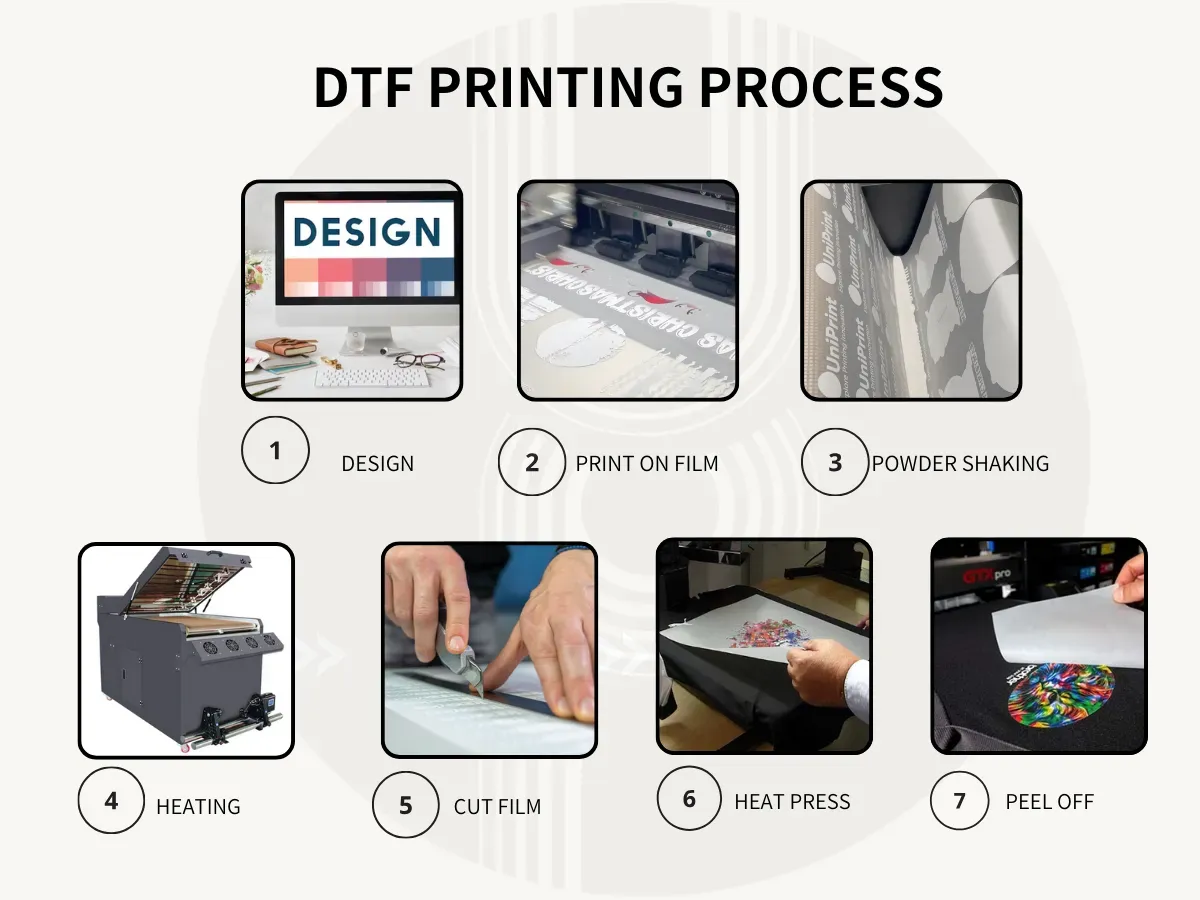
DTF printing has transformed how designers, small shops, and hobbyists approach garment decoration. Short for Direct-to-Film transfers, this method lets you print vibrant designs onto a clear PET film, coat them with an adhesive powder, and transfer them onto a wide range of fabrics with a heat press for DTF. If you’re exploring faster turnarounds, large color ranges, or working with odd fabric blends, this technique offers compelling advantages. Its ability to support a white underbase and stay forgiving across fabrics makes the DTF printing process a popular choice for small shops pursuing on-demand production. This guide covers the DTF transfer workflow, the supplies you’ll need, and practical tips to achieve durable, vibrant results.
Outside of the term DTF printing, many users describe it as direct-to-film transfers or a film-based transfer method that prints on PET film. In practice, the workflow includes printing a design with pigment inks, applying adhesive powder, curing the powder, and transferring the image to fabric with a heat press for DTF. For sourcing, consider reliable DTF printing supplies such as films, powders, and compatible printers to optimize results across fabrics. From an SEO perspective, using alternative terms like direct-to-film transfers and pigment-on-film processes helps connect related searches while preserving the core meaning of this versatile technique.
DTF Transfer Fundamentals: What Direct-to-Film Transfers Mean for Garment Decoration
DTF transfer, or direct-to-film transfers, represent a digital approach to garment decoration where designs are printed onto a clear PET film, then bonded to fabric with an adhesive powder and heat. This workflow centers on a white underbase and color layers that are transformed into a transferable image once heat is applied.
This method offers a versatile path for designers and small shops to decorate a wide range of fabrics with vibrant colors and durable transfer quality. By understanding the DTF transfer concept, you can anticipate how a white underbase, accurate color reproduction, and reliable curing contribute to consistent results when using a heat press for DTF.
DTF Printing Process: From Design to Durable Transfers
The DTF printing process flows from artwork to film and finally to fabric. It starts with designing and color management, then printing on DTF film with pigment inks, applying adhesive powder, curing, and ending with transfer under heat and pressure.
Understanding the process details—color management, ICC profiles, and proper powder curing—helps ensure color fidelity and sharp edge definition. Optimizing the print path and using appropriate RIP software improve predictability when producing direct-to-film transfers.
DTF printing Supplies: Building a Reliable Toolset for Consistent Results
A solid DTF printing supplies lineup includes a pigment-ink printer, DTF film, adhesive powder, curing equipment, and a dependable heat press for DTF operations. Having quality substrates and calibration tools also supports consistent results across runs.
Investing in durable DTF printing supplies and proper maintenance tools—such as cleaning kits, calibration references, and color management resources—helps maintain print quality, reduces downtime, and supports repeatable outcomes across projects.
Substrates and Film Compatibility for DTF Transfers
DTF transfers can be applied to cotton, cotton blends, and some polyesters, but substrate behavior varies by moisture content, texture, and fiber composition. Substrate testing on each new fabric is essential to dial in temperature, time, and pressure for reliable results.
Differences in film choice and adhesive powder type can affect adhesion, hand feel, and opacity. For diverse fabrics, maintain a small library of tests and document the optimal settings for each substrate to ensure consistent results across direct-to-film transfers.
Heat Press for DTF: Settings, Techniques, and Best Practices
The heat press for DTF requires careful control of time, temperature, and pressure. Settings vary with film, ink, adhesive powder, and fabric, so start with manufacturer-recommended guidelines and adjust based on test transfers.
To maximize transfer quality, ensure even pressure with a stable platen, use a protective sheet, and preheat the substrate. Cooling and post-press care can influence cure and wash-fastness, so document the optimal press sequence and handling practices for reliable DTF results.
Troubleshooting and Quality Assurance in DTF Transfers
Common issues like ghosting, weak white underbase, or powder shedding often stem from misaligned prints, insufficient curing, or substrate mismatch. Systematic checks—color management calibration, film handling, and ensuring complete cure—help diagnose root causes.
Regular quality assurance practices, including test prints on target fabrics and standardized wash tests, guide improvements in durability and color fidelity. Clear care instructions for customers also support longer life for direct-to-film transfers.
Frequently Asked Questions
What is the DTF printing process and how does it work on various fabrics?
The DTF printing process uses pigment inks printed onto a PET film with a white underbase, then adhesive powder is applied and cured. The design is transferred to fabrics with a heat press, producing durable, vibrant direct-to-film transfers. It works on cotton, blends, polyesters, and many fabrics, often without pretreatment.
What are the essential DTF printing supplies and what does each component do?
Core DTF printing supplies include a DTF printer with pigment inks, DTF film, adhesive powder, a powder curing unit, a heat press, RIP software with color profiles, and cleaning/calibration tools. The printer lays down the white underbase and color, the film carries the image, the adhesive powder bonds when heated, curing sets the powder, the heat press applies heat and pressure for transfer, and RIP software manages color fidelity.
What settings should I use on a heat press for DTF transfers to ensure durable results?
For heat press for DTF transfers, start with the manufacturer’s recommendations for the adhesive powder and film, then test on your fabric type. Key factors are stable temperature, even pressure, and accurate timing; adjust for fabric weight, blend, and color. Ensure the powder is fully cured before transfer to prevent ghosting.
Why is a white underbase important in DTF transfer designs, and how is it achieved in the DTF printing process?
The white underbase is crucial for bright, opaque color on dark fabrics in the DTF transfer. In the DTF printing process, the white layer is printed first on the film before color layers, then adhesive is applied; during transfer, heat activates the adhesive to bond the image to the fabric.
How do you troubleshoot common issues in DTF printing, such as ghosting or powder shedding during the DTF printing process?
Troubleshoot by verifying full cure of the adhesive powder, ensuring even powder distribution, and checking film alignment to prevent ghosting. Also review color management, keep the print path clean to avoid ink smudges, and ensure consistent heat and pressure during transfer to prevent powder shedding.
What substrates work best with direct-to-film transfers, and how should I test fabrics when using DTF printing supplies?
DTF works well on cotton, cotton blends, and some polyesters, but results vary by fabric. Always test on a sample garment when using new fabrics and DTF printing supplies, then adjust temperature, time, and pressure based on the substrate and adhesive for optimal performance.
| Topic | Key Points |
|---|---|
| What is DTF printing? | Digital textile printing using pigment inks on PET film; white underbase + color layers; adhesive powder; heat transfer to fabrics; versatile, often no pretreatment; durable, vibrant transfers. |
| Why choose DTF printing? | Rich color and smooth gradients; white underbase for bright colors on dark fabrics; forgiving across fabrics; scalable workflow for small runs to large batches; supports on-demand customization. |
| DTF printing process (overview) | 1) Design and color management; 2) Print on DTF film with white underbase; 3) Apply adhesive powder; 4) Cure powder; 5) Align and transfer with heat and pressure; 6) Finish and care, cooldown as needed. |
| DTF supplies and equipment | DTF printer with pigment inks; DTF film; adhesive powder; powder curing unit; heat press; RIP software and color profiles; cleaning and calibration tools. |
| Substrates and film compatibility | Cotton, cotton blends, some polyesters; test new fabrics; adjust temperature, time, pressure; film and powder choice influence results. |
| DTF vs other transfer methods | Compared to DTG and sublimation: DTF is flexible, pretreatment-free on many fabrics, handles white underbase well, good for small runs and varied designs; DTG may feel softer on some fabrics; sublimation works best on polyester and requires specific fabrics. |
| Practical tips for reliable DTF results | Calibrate color management; run test prints; even powder distribution; consistent curing; stable temperature and pressure; store films flat and clean; educate customers on care. |
| Common issues and troubleshooting | Ghosting, weak white underbase brightness, powder clumping, cracking after wash; solutions: check underbase, film alignment, curing, powder consistency, fabric compatibility, bonding temperature and press time. |
| Best practices for durable results | Use high-quality film and powder; clean print path; maintain printer; optimize color mapping; test on dark and light fabrics; provide care instructions to customers. |
| Conclusion | DTF printing offers a flexible, cost-effective approach to garment decoration across diverse fabrics and on-demand production; with proper process understanding, supplies, color management, curing, and transfer steps, you can produce vibrant, durable transfers for a wide range of textiles. |
Summary
DTF printing offers a flexible, cost-effective approach to garment decoration across diverse fabrics and on-demand production; with proper process understanding, supplies, color management, curing, and transfer steps, you can produce vibrant, durable transfers for a wide range of textiles.